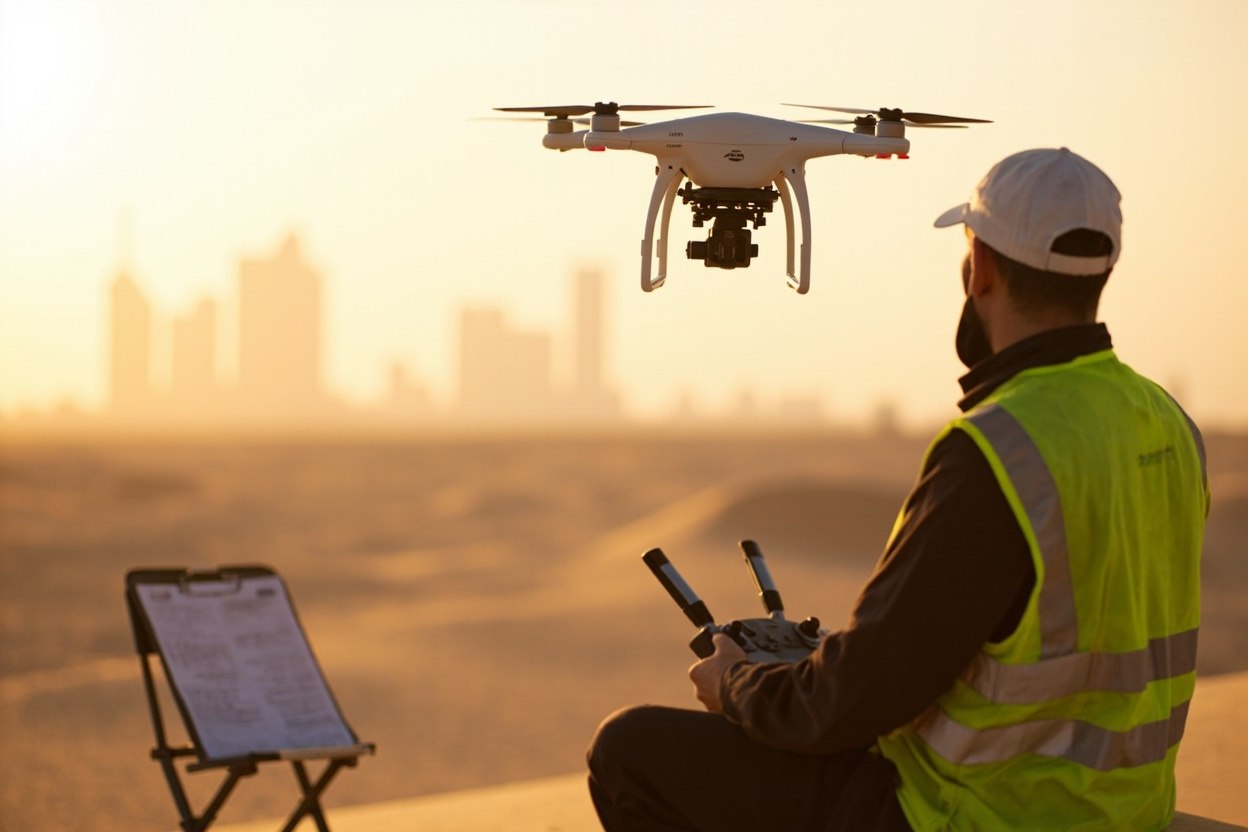
In short A Dubai production house flies commercially only after three approvals are in place: a GCAA UAS organisation registration with operator approval, a DCAA registration of each aircraft by serial number, and a DFTC filming permit covering the location and the time slot. The GCAA registration runs through the federal UAS Gateway, the DCAA registration runs through the DCAA portal, and the DFTC permit runs through the Commission. Operational rules apply regardless of permit status: a 122-metre ceiling, daylight operation, visual line of sight, and a minimum of 50 metres from people and property not under the production's control. Fines under Federal Law No. 11 of 2026 and Dubai Law No. 4 of 2020 reach AED 500,000 in the highest band.
Last checked against the sources below: 30 September 2026.
What the drone layer actually is
The drone layer is a second permit stack stacked on top of the Dubai Film and TV Commission filming permit. The DFTC filming permit authorises the crew to be at a chosen location and to use cameras, lighting and grip there. The drone layer authorises the aircraft to take off, to fly along a described route, and to record from the air. Both have to be cleared before the crew rolls camera on a commercial aerial shot.
For a Dubai production house, the practical consequence is that an aerial shot scheduled for a single morning shoot has a planning lead time measured in weeks. The GCAA registration opens the moment the aircraft is acquired, the DCAA approval comes through once the operator is licensed, and the DFTC permit covers the actual shoot day. None of the three covers the others.
Why Dubai treats drones as a separate permit track
The federal GCAA classifies drones as unmanned aircraft under Civil Aviation Regulations Part IX. Dubai applies Dubai Law No. 4 of 2020, which gives the DCAA authority over drone permits, operating areas, pilot requirements and aircraft registration. The Dubai law applies across the emirate, including the free zones.
The rules are split because aviation safety is a federal matter but local enforcement sits with the emirate. The federal layer registers the organisation and the pilot. The local layer permits the specific flight.
The two regulators, and what each one signs off
The General Civil Aviation Authority is the federal regulator. The GCAA runs the UAS Gateway portal, where drone operators register organisations, register individual aircraft by serial number, apply for the security clearance that commercial operations require, and file the operator approval. The GCAA registration is a precondition for the local DCAA approval.
The Dubai Civil Aviation Authority is the local Dubai regulator. The DCAA runs its own portal, where a Dubai-licensed operator files the operator approval under DCAR-UAS, registers each aircraft for the Basic or Advanced operating category, holds the Commercial Basic or Advanced pilot licence, and files the mission approval for each commercial job.
The DFTC is the film commission, not an aviation regulator. The DFTC filming permit covers the crew, the ground equipment, and the use of a location in Dubai. The DFTC does not authorise the aircraft to fly.
The four categories, and which one your shoot sits in
The DCAA classifies drone operations into Basic, Advanced and Certified categories. The classification is operational, not equipment-based. A small drone doing a tree-line survey in a desert area sits in Basic. The same drone doing a roof inspection in a downtown corridor sits in Advanced, because flights near buildings are an Advanced trigger.
Basic operations are subject to limits: maximum take-off mass below 25 kg, visual line of sight, the pilot in a fixed location, a ceiling of 122 metres or 400 feet, aircraft dimensions below 3 metres, maximum speed below 19 metres per second, and uncontrolled airspace.
Advanced operations cover higher-risk missions. The DCAA list includes BVLOS flights, delivery or dropping of materials, flights over buildings and infrastructure, flights near uninvolved people, cross-emirate operations, and urban operations. The practical test is whether the location is urban, whether uninvolved people are in the flight path, and whether the drone will fly beyond visual line of sight.
The aircraft sits in one of four weight categories in the 2026 GCAA guidance: Category A under 250 g, Category B 250 g to 4 kg, Category C 4 kg to 25 kg, Category D over 25 kg.
The licence and the registration: which is which
The GCAA registers organisations and aircraft. The DCAA authorises operators and pilots. A production house needs both to be live before any commercial work is flown.
At the federal stage, a commercial operator registers the organisation through the UAS Gateway, submits security clearance for the legal representative, and registers each drone by make, model and serial number. Published recreational fee is approximately 250 AED per drone per year; commercial fee range 1,500 to 5,000 AED per year per drone. Each drone is registered individually.
At the Dubai stage, the operator needs a DCAA organisation approval under DCAR-UAS, a Dubai-licensed trade licence, a valid Commercial Basic or Advanced pilot licence, the UAS Operations Manual, valid third-party liability insurance with a 1 million AED minimum, the GCAA security clearance, and the Safety Management System and Emergency Response Plan for Advanced operations. Published DCAA commercial registration fee is AED 500 plus AED 20 in statutory fees.
The 122-metre ceiling, line of sight and the other in-the-field rules
The operational rules apply regardless of permit status, and to every drone flight, not only commercial flights.
The published ceiling is 122 metres or 400 feet AGL, with reductions in urban corridors. The minimum distance from people, vehicles and property not under the production's control is 50 metres. Visual line of sight is required at all times. Night flying is allowed only with explicit approval. Flying over uninvolved people is restricted under the Advanced category.
FPV flights follow the same permit process. A visual observer is required. Sub-250 g exemptions seen in some other countries do not apply in Dubai.
Three habits are worth a pre-flight routine. Check the UAE drone Fly Zone Map app on the morning of the shoot. Carry the DCAA mission approval, the GCAA registration certificate and the pilot licence. Keep the third-party liability insurance certificate accessible.
Where you can and cannot fly in Dubai
The UAE publishes a drone fly-zone map with three colours. Green is permitted, red is prohibited, and yellow requires prior authorisation. The map is updated in real time.
There is a 5 km no-fly radius around all UAE airports, including Dubai International (DXB), Al Maktoum (DWC), Sharjah (SHJ), Abu Dhabi (AUH) and Ras Al Khaimah (RAK). Government buildings, royal palaces and diplomatic missions are no-fly zones, typically with a 2 km radius. Military installations are absolute prohibition. Oil and gas infrastructure has a 2 km no-fly buffer.
Downtown Dubai, the Burj Khalifa, the Palm Jumeirah, Dubai Marina and the other central areas are not absolute no-fly zones, but they require special DCAA permits for any drone activity. Designated flying parks exist outside the central area, including parts of Al Qudra and approved portions of the Dubai Desert Conservation Reserve.
The fees you actually pay, in the order you pay them
Published fees fall into three. GCAA fees cover the organisation registration, the aircraft registration, the security clearance and the operator approval. DCAA fees cover the local operator approval, the aircraft registration under DCAR-UAS, the pilot licence, and the mission approval. Insurance is a separate commercial line.
At the federal stage, recreational registration is approximately 250 AED per drone per year. Commercial registration is 1,500 to 5,000 AED per year per drone, depending on the category.
At the DCAA stage, the commercial registration fee is AED 500 plus AED 20 in statutory fees. The mission approval fee is per-mission, depending on the operating category, airspace class and duration.
Third-party liability insurance is mandatory, minimum 1 million AED for routine operations. The insurer's certificate is filed with the DCAA mission application. An expired certificate is treated as no certificate.
The fine schedule, and where the press overstates it
The fines are codified in two instruments. Federal Law No. 11 of 2026 updated the earlier federal drone decree. Dubai Law No. 4 of 2020 sets the emirate-level bands. The two layers stack.
The federal bands cover five categories. Flying without registration costs AED 10,000 to AED 50,000, plus confiscation. Flying in restricted airspace adds up to AED 100,000, with potential imprisonment. Commercial operation without a licence costs AED 50,000 to AED 200,000. Privacy violations are criminal under the UAE Cybercrime Law, with imprisonment up to six months. Interfering with aviation is criminal prosecution, with potential life imprisonment if the act endangers aircraft safety.
The Dubai bands run higher, including AED 50,000 to AED 500,000 for operating an unregistered drone, flying without a permit, entering restricted airspace, endangering people or property, or breaching privacy.
The press has overstated some figures. The federal ceiling on the highest band is AED 100,000 under the 2026 federal text, not the half-million AED older Dubai-only pieces cite. The figures above are taken from the current texts, and should be confirmed against the live text before any compliance work relies on them.
How the drone permit sits on top of the DFTC filming permit
The DFTC filming permit covers the crew, the equipment on the ground and the use of a Dubai location. The drone layer covers the aircraft. The two have to be lined up at the same time, and the DFTC filing has to reference the drone operator and the planned flight time.
The DFTC application runs through the Commission portal, supported by a UAE-licensed production company. Published processing time is two to five working days.
The drone layer adds two documents: the DCAA mission approval with route, date, time window, operating category and aircraft serial numbers, and the GCAA operator approval with the pilot licence. The DFTC will not release the location permit for aerial shoots without the drone layer in place.
For a single-location, single-day shoot, both filings can clear in the same week. For a multi-day shoot with location moves, each move is a fresh DFTC filing and each route change is a fresh DCAA mission approval.
Insurance, and why commercial aerial work cannot skip it
Third-party liability insurance is mandatory, and the cover has to be in place before the DCAA mission approval is filed. Published minimum is 1 million AED for routine operations, with higher minimums for Advanced work and urban flights. The cover has to be issued by a UAE-licensed insurer, and the certificate filed with the DCAA as part of the mission package.
The minimum is a floor, not a ceiling. A production house working on a high-value commercial shoot or a public event will need cover materially above 1 million AED. The premium scales with the cover amount, the operating category, and the pilot's experience.
The certificate has to be current at the time of the flight. An expired certificate is no certificate on the morning of the shoot. Set the policy renewal date on a known anniversary, file the renewal certificate with the DCAA before the policy lapses, and carry a printed certificate on every shoot.
The equipment import side, and how the carnet overlaps
Bringing drone kit into the UAE has to clear two parallel tracks. The aviation track covers the aircraft registration and operating approval. The customs track covers the import or temporary admission of the equipment.
The UAE accepts the ATA Carnet for professional film equipment on a temporary basis. Camera, lighting, grip and sound equipment enters without paying duty, provided the carnet lists every item by description and serial number and the kit leaves the country again within the carnet's validity period. Without a carnet, Dubai Customs requires a refundable deposit plus a customs broker at the airport.
Drones, radio microphones and satellite equipment are regulated separately. Declare them on the permit application before the crew flies.
The pre-production checklist for a Dubai drone shoot
Seven items belong on the call sheet before the aircraft takes off. First, confirm the GCAA organisation registration is live and that the security clearance has not lapsed. Second, confirm every aircraft is registered by serial number under both the GCAA and the DCAA. Third, confirm the operating pilot holds the right DCAA licence for the operating category. Fourth, confirm the DCAA mission approval is in place for the specific route, date and time window, naming the same serial numbers that will fly. Fifth, confirm the DFTC filming permit references the DCAA mission approval number. Sixth, confirm the third-party liability insurance certificate is current. Seventh, run the UAE drone Fly Zone Map on the morning of the shoot.
If any item fails, the shoot does not start. The cheapest way to manage this is a single checklist in the pre-production calendar.
What we are watching for the rest of 2026 and into 2027
Three things are worth watching. The first is the DCAA's published list of designated flying parks, updated outside the DCAR-UAS rule text. The live list on the DCAA portal is the version to rely on.
The second is the federal drone suspension reported phased out effective 30 June 2026. Normal licensing and mission approvals still apply, and airspace restrictions can change quickly. Check current GCAA and DCAA notices before every commercial job.
The third is the Abu Dhabi film rebate, at 35% of qualifying spend, rising to 50% through a points-based uplift for UAE content. The Abu Dhabi rebate covers the Abu Dhabi, Al Ain and Al Dhafra regions only.
A note on what this page is not
This page is an orientation for production houses and brand clients planning commercial drone work in Dubai in 2026. It is not legal advice, and it is not a substitute for reading the current DCAR-UAS rule set on the DCAA portal, the GCAA registration guidance on the UAS Gateway, the published text of Federal Law No. 11 of 2026 and Dubai Law No. 4 of 2020, or the live DCAA notices on airspace restrictions and suspension orders.
The fine figures and the operational figures listed here are taken from published summaries and from the live rules, and they were checked against the DCAA portal and the GCAA UAS Gateway on the date in the line above. Where the summaries and the live text disagree, the live text on the regulator's own portal wins. A pilot, an operator or a production house making a compliance decision on a specific job should confirm the live figures on the morning of the decision, not the morning of the planning meeting.
What this page is, is the working sequence for a Dubai production house in 2026. Register the organisation with the GCAA, register each aircraft by serial number, hold the DCAA operator approval and the pilot licence, file the mission approval for the specific route and date, hold the DFTC filming permit for the location, carry the third-party liability insurance certificate, and check the fly-zone map on the morning of the shoot. The rest of the production can run on the DFTC permit as it always has.
Questions
- What is the drone filming permit in Dubai?
- A drone filming permit in Dubai is the combination of three documents: a GCAA UAS organisation registration and aircraft registration, a DCAA operator approval and mission approval under the current DCAR-UAS rule set, and a DFTC filming permit covering the location and the time slot. The three are filed separately and all three are required for commercial drone work in Dubai.
- Do I need a separate permit for every commercial drone flight?
- Yes. The DCAA mission approval covers one set of dates at one location along one described route. A change of route, a change of date or a change of aircraft serial numbers is a fresh filing, not an amendment. A multi-day shoot with location moves is a stack of mission approvals, not a single one.
- Does the DFTC filming permit cover the drone approval?
- No. The DFTC filming permit authorises the crew to film at a chosen location in Dubai. The DCAA mission approval authorises the aircraft to take off and to fly the described route. The two are filed separately and both are required for a commercial aerial shoot.
- Do I need a carnet for drone kit coming into the UAE?
- The UAE accepts the ATA Carnet for professional film equipment on a temporary basis, and drones are covered by the carnet when the carnet lists every item by description and serial number. Drones, radio microphones and satellite equipment are regulated separately and can be held at customs without prior approvals, so the equipment has to be declared on the permit application before the crew flies.
- What is the minimum insurance for commercial drone work in Dubai?
- The minimum is 1 million AED in third-party liability cover for routine commercial operations, with higher minimums for Advanced operations and for flights in urban corridors. The certificate has to be issued by a UAE-licensed insurer and filed with the DCAA mission approval, and it has to be current at the time of the flight.
- What are the fines for flying without the drone permit in Dubai?
- Federal Law No. 11 of 2026 and Dubai Law No. 4 of 2020 set the bands. Flying without registration costs AED 10,000 to AED 50,000, with confiscation. Flying in restricted airspace adds up to AED 100,000 and possible imprisonment. Commercial operation without a licence costs AED 50,000 to AED 200,000. The published Dubai bands run up to AED 500,000 for the most serious air-navigation violations, with possible imprisonment added.
- Can I fly a sub-250-gram drone in Dubai without registration?
- No. The published GCAA guidance is that the UAE does not have a blanket sub-250 g exemption for camera drones. A camera-equipped drone under 250 g technically requires registration, and outdoor flights in public areas with any recording capability should be registered regardless of weight. Indoor flights in private premises are treated separately, and enforcement for indoor whoops is described as minimal in practice.
Sources
Planning something in the UAE?