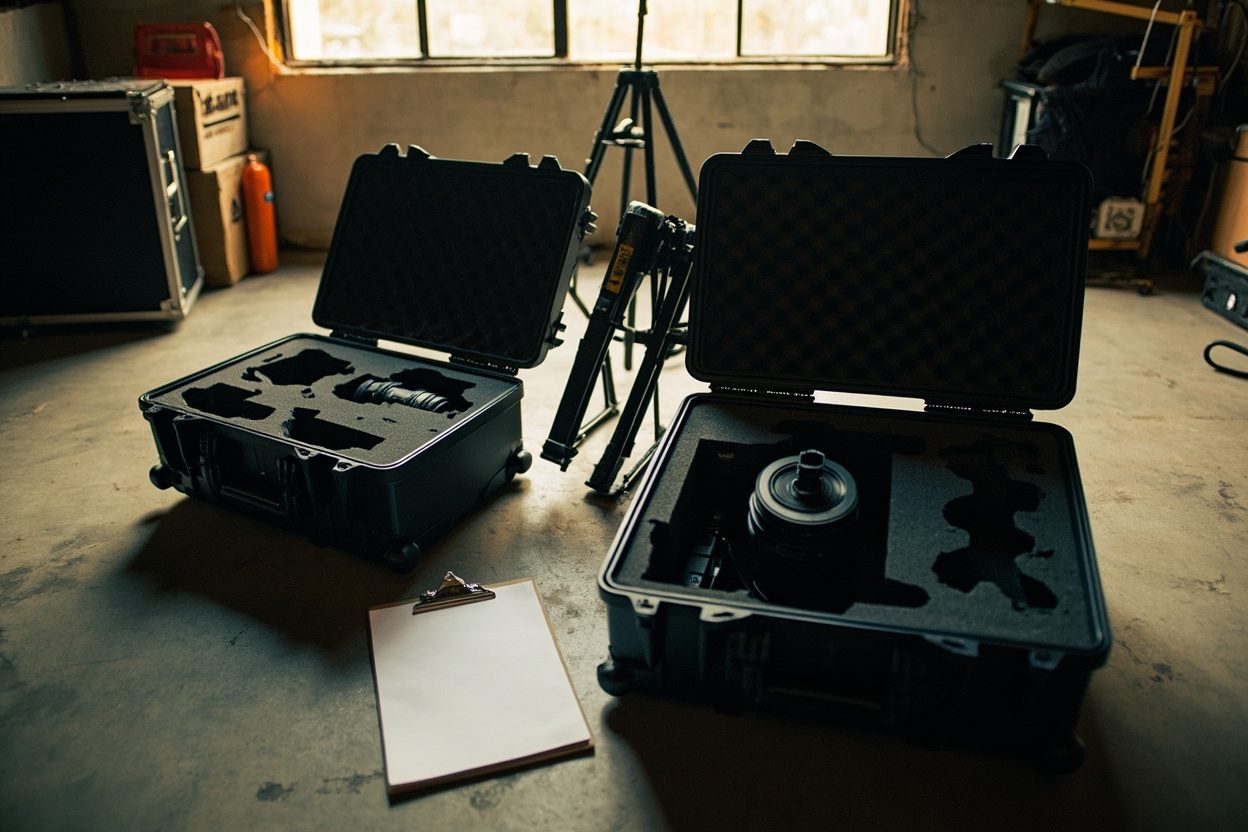
In short: the UAE joined the ATA Carnet system in 2011 for exhibitions and trade fairs, and carnet issuers abroad still list it that way, so a carnet is not a safe assumption for a film crew's kit. The dependable route is a temporary admission declaration with Dubai Customs: a refundable deposit equal to the customs duty (5% of the CIF value on most goods), made by a company with a Dubai customs code, and refunded when the kit leaves. Filming equipment, drones and wireless devices also need permits from the relevant authorities, so plan the paperwork with your local production house before anything is packed.
Published 25 September 2026. Carving Dreams, Dubai.
Last checked against the sources below: 25 September 2026.
Every international shoot in Dubai starts with the same question from the camera department: can we bring our own package? Usually the answer is yes. The harder question is how it gets through customs without the production paying duty on a camera it is going to fly home again in a fortnight.
In Europe, North America and much of Asia, the reflex answer is an ATA Carnet, the "passport for goods" that lets professional equipment in and out of member countries without duty. The UAE is a member. But the UAE's membership covers less than many producers expect, and a crew that arrives with a carnet and nothing else can find itself paying a deposit at the airport, or worse, waiting while the paperwork is sorted out. This note sets out what the official sources say and how we would plan it.
Does the UAE accept ATA Carnets for film equipment?
The honest answer is: not reliably, and you should not plan on it without written confirmation.
- What the UAE joined, and when. The UAE began accepting ATA Carnets on 1 April 2011. Khaleej Times reported at the time that the scheme started with goods for use at trade fairs, shows and exhibitions, with Dubai Chamber as the national guaranteeing and issuing body, and that commercial samples and professional equipment were meant to follow.
- What issuers abroad say now. The US carnet issuer's published advisory for the UAE still describes acceptable goods as those travelling for trade shows, meetings or similar events, and says the UAE began accepting carnets for exhibitions and fairs. A UK issuer's country list goes further: it says carnets for the UAE can only be issued for goods going to an international trade fair or exhibition.
- What Dubai Customs says. The Dubai Customs FAQ answers the temporary import question for goods brought in "for exhibition or as sample", and explains that goods covered by an ATA Carnet need no deposit, with temporary admission lasting six months or until the carnet expires, whichever comes first.
Put together, the carnet works cleanly for exhibition goods. For a camera package arriving for a commercial or a feature, the position is at best unclear. If your home chamber will issue a carnet for the UAE and you want to use it, ask the issuer in writing whether it covers professional equipment for filming, and ask Dubai Customs (through the production house or a clearing agent) whether it will be accepted at your port of entry. Without both answers, plan for the deposit route below.
If you do travel on a carnet, the US issuer's advisory on UAE rules lists some specifics worth knowing: split shipments are not allowed, so everything that comes in on one carnet must leave together; replacement carnets are not accepted; and customs can charge a regularisation fee of up to AED 5,000 if the carnet is not presented for validation when the goods leave. Build the validation into the wrap-day schedule.
How does temporary admission with a deposit work?
This is the route Dubai Customs describes for goods that come in and go out again. It is less elegant than a carnet, but it is predictable.
- Use a company with a customs code. The Dubai Customs FAQ says the entity bringing goods in for a temporary purpose must hold a customs business code, obtained on the strength of its mainland licence. In practice that means your local production house or a licensed clearing and forwarding agent, which Dubai Customs allows to clear goods on an owner's behalf with authorisation.
- Prepare an itemised list. Every body, lens, monitor, light and case, with serial numbers and values. The deposit is calculated from these values and the refund is checked against them, so a vague list costs money on the way out.
- File the temporary admission declaration. The Dubai Customs Service Guide lists the fee for a temporary admission declaration as AED 100, with a further AED 20 knowledge and innovation fee added to any service costing AED 50 or more.
- Pay the deposit. Dubai Customs takes a deposit equal to the customs duty on the items, which it refunds when the goods are re-exported within the time allowed. The FAQ gives the general customs duty rate in Dubai as 5% of the CIF value (cost, insurance and freight), with higher rates for alcohol and cigarettes.
- Re-export everything, and prove it. The refund depends on showing that the goods left. For goods travelling with passengers, the service guide says the deposit is refunded after customs inspects and verifies the inbound goods on departure, and that if not all of them are re-exported the deposit is reduced in proportion.
- Close the paperwork. The service guide says customs declaration documents must reach the customs office within 30 days, with a late fee of AED 5 a day after that, and that no refund claim is accepted until the documents are submitted. Someone has to own that task after the crew has flown home.
A worked example makes the scale clear. A camera and lens package declared at AED 400,000 would carry a deposit in the region of AED 20,000 at 5%, before the declaration fee. That money comes back, but it is out of the production's account for the length of the shoot and the refund process, so put it in the cash flow plan.
Which equipment needs a permit as well as customs clearance?
Customs duty is only half of it. The Dubai Customs Passenger Customs Guide lists goods that are "subject to permits by relevant authorities" when they travel with passengers. Three entries on that list matter to a crew:
- Filming equipment for news stories, films or official events. It is listed in its own right. Your filming permit file, which a UAE-licensed production company submits to the Dubai Film and TV Commission, is where the production is authorised; the steps are in how to film in Dubai. Keep a copy of the permit and the equipment list together for customs.
- Wireless devices. Radio microphones, in-ear monitors, wireless video transmitters and walkie-talkies all transmit. The Telecommunications and Digital Government Regulatory Authority (TDRA) issues customs release permits for telecommunications equipment, including a temporary permit type. TDRA lists the service as free of charge with an expected time of one working hour, but the device must meet TDRA's technical requirements, and companies must be registered with TDRA. Check frequencies before you pack: kit legal at home may not be legal here.
- Drones. Listed separately, and currently the item that needs the most checking (see below).
The practical rule: if it flies, transmits or exists only to film, assume it needs a permit and ask before it ships.
What about drones in 2026?
Drones need the aviation approvals described in our drone filming guide as well as customs clearance. This year there is an extra step. On 28 February 2026 the General Civil Aviation Authority issued Safety Decision 2026-03, and its second issue, dated 27 March 2026, suspended all authorisations for drones (commercial and recreational), light sport aircraft, balloons and specialised operations, aerial photography included. It banned flights and new approvals during the suspension unless the GCAA granted a specific written exemption, and it said the decision could be amended, extended or cancelled.
Industry reports say commercial drone work has since resumed, but we have not found the change on an official GCAA or DCAA page, so we are not stating it as fact here. Before a drone is packed for the UAE, get the current position from the GCAA and the Dubai Civil Aviation Authority in writing. Shipping a drone that cannot legally fly is an expensive way to find out. For many projects, hiring a locally registered drone operator removes both the customs and the airspace question.
Is it simpler to hire the kit in Dubai?
Often, yes. Dubai has a deep rental market for cameras, lenses, lighting and grip, and hiring locally removes the deposit, the permits for imported devices and the risk of a case being held at the airport. It also removes excess baggage and freight costs in both directions.
The trade-off is familiarity. A director of photography who has lit with the same package for years may not want to change it for a commercial with two shoot days. A sensible split is common: bring the camera body, lenses and any specialist items the look depends on, and hire the lighting, grip, power and heavy stands locally. We handle crewed and dry hire as part of a production, and the useful first step is a real kit list.
| Route | Best for | Money tied up | Watch out for |
|---|---|---|---|
| ATA Carnet | Exhibition and trade fair goods; film kit only with written confirmation | Carnet fees and guarantee at home; no UAE deposit if accepted | Acceptance for film equipment; validation at exit; no split shipments |
| Temporary admission with deposit | Own camera packages on a shoot of a few weeks | Deposit equal to duty, about 5% of CIF value, plus fees | Needs a company with a customs code; paperwork within 30 days for the refund |
| Local hire | Lighting, grip, power, most camera packages | Rental only | Book early in peak season; check models and accessories match your spec |
What if you are taking kit out of the UAE?
The direction also matters. A UAE-based company taking equipment abroad, for example a Dubai crew shooting in a carnet country, can get a carnet from Dubai Chambers, which issues them to members and non-members. Its service page lists fees for a single visit of AED 900 (standard) or AED 1,400 (express) for members, and AED 1,800 or AED 2,300 for non-members, plus a refundable security deposit calculated from the value of the goods and the duties in the countries visited. It quotes processing times of two working days, or one on the express service. The carnet itself is valid for up to a year.
A timeline that works
For a visiting crew bringing its own camera package to Dubai, this is the order we would work in:
- Six weeks out. Appoint the licensed production house that will hold the filming permit (see hiring a production house in Dubai), send the draft kit list and decide what travels and what is hired locally.
- Four weeks out. Confirm the customs route. If you want to use a carnet, get written answers from your issuer and via the local side from Dubai Customs. Otherwise, line up the company or agent that will file the temporary admission declaration and agree who funds the deposit.
- Three weeks out. Check every transmitting device against TDRA's requirements and apply for release permits. Get the current drone position in writing if aerials are planned.
- Before departure. Final itemised list with serial numbers and values, matching the declaration exactly. Copies of the filming permit and any TDRA permits in the kit cases.
- Wrap. Pack against the same list, present the goods for exit inspection, and make sure the documents reach customs within 30 days so the deposit can be refunded.
Weather can move shoot days in winter, which can stretch a temporary admission period, so read our note on this season's El Niño forecast before fixing dates tightly. If you are planning a shoot and want to talk through what to bring and what to hire, send the kit list and dates to lata@carvingdreamsevent.com.
Questions
- Can I use an ATA Carnet for camera equipment in Dubai?
- Do not assume so. The UAE joined the carnet system in 2011 for exhibition and trade fair goods, and carnet issuers abroad still list it that way. Get written confirmation from your issuer and Dubai Customs first, or plan on a temporary admission declaration with a refundable deposit.
- How much is the customs deposit on film equipment in Dubai?
- Dubai Customs takes a deposit equal to the customs duty on the goods, and the general duty rate is 5% of the CIF value. It is refunded after the goods are inspected and re-exported, once the declaration documents are submitted.
- Do I need a permit to bring wireless microphones into the UAE?
- Wireless devices are on the Dubai Customs list of goods subject to permits. TDRA issues customs release permits for telecommunications equipment, including a temporary type, and the equipment must meet TDRA's technical requirements.
- Can I bring my own drone to film in Dubai?
- Drones are subject to permits at customs and need GCAA and DCAA approvals to fly. The GCAA suspended drone authorisations in 2026, so confirm the current position in writing before shipping one, or hire a locally registered operator.
Planning something in the UAE?