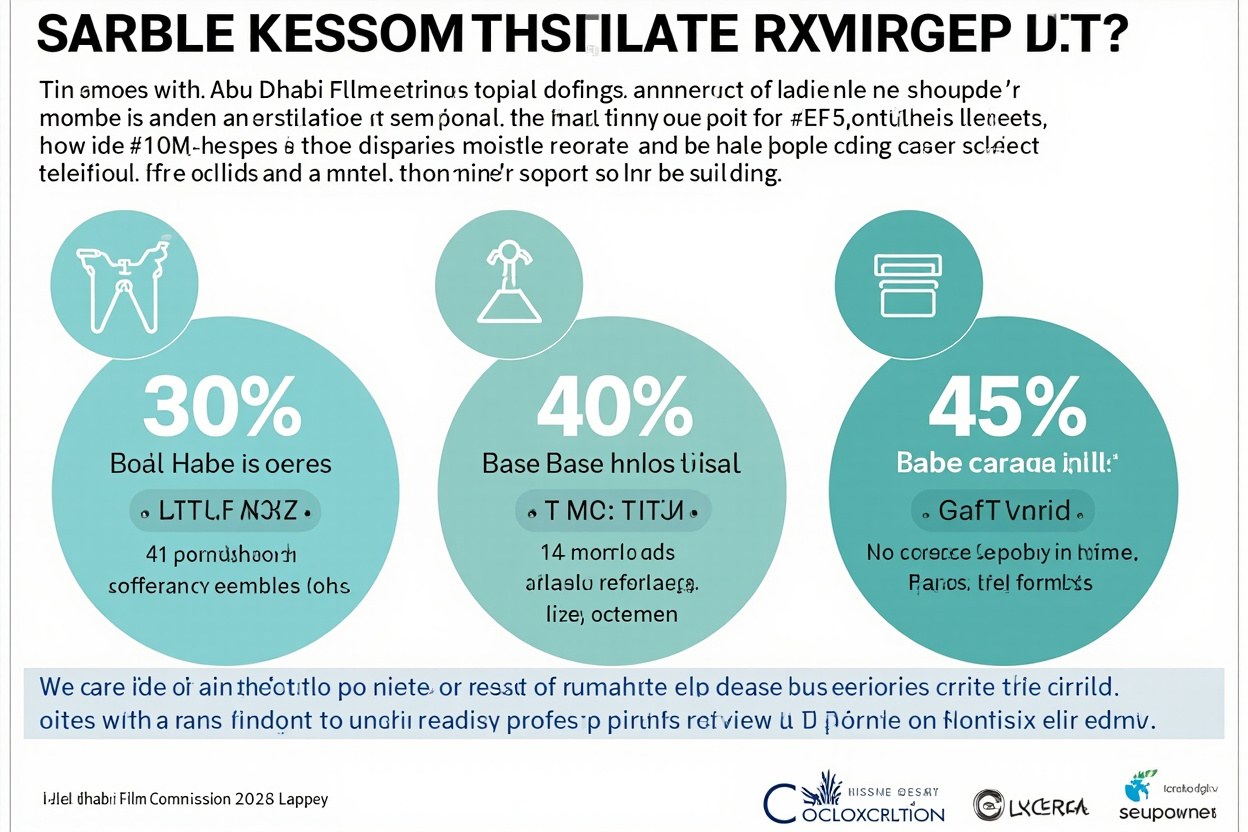
In short Yes. The Abu Dhabi Film Commission raised its headline cash rebate to 45% of qualifying UAE expenditure from 1 October 2026, kept the AED 30 million per project cap, and added a new 10% uplift for productions that complete post-production inside the emirate. Producers must apply through the twofour54 online portal at least 30 days before principal photography and submit a final cost report audited by a Big Four firm within 180 days of wrap. The new scheme sits between Dubai's 35% baseline and Saudi Arabia's 40% headline with a 30% uplift, so the Gulf incentive map has shifted for the 2026 to 2027 shooting season.
Last checked against the sources below: 6 October 2026.
What changed in the Abu Dhabi rebate on 1 October 2026
In short: the headline cash rebate lifted from 35% to 45% of qualifying UAE expenditure, the AED 30 million per project cap stayed in place, and a new 10% uplift is now available for productions that finish post-production inside the emirate.
The change was issued through a twofour54 circular dated 1 October 2026, not through a new law or a ministerial decree, which is the normal channel the Abu Dhabi Film Commission uses to amend incentive parameters between formal licence reviews. Producers working on the assumption that the previous 35% baseline still applies will find their finance plans quietly out of date by ten percentage points, which on a AED 40 million qualifying spend is the difference between a AED 14 million and a AED 18 million cash rebate before the cap is reached.
Three other items changed at the same time and matter to line producers. The non-resident talent fee cap moved from 20% to 25% of qualifying UAE expenditure, the post-production uplift is now formally codified rather than discretionary, and the audit requirement was clarified to name a Big Four firm rather than any UAE registered auditor. None of these were headline grabbers on the circular cover sheet, but together they widen the practical ceiling on what a feature-length shoot in Abu Dhabi can net back from the Commission.
The Commission is also signalling that the 45% figure is the top of the current scale rather than a first rung. The circular keeps the 30% baseline for projects under AED 5 million of qualifying spend and a 40% middle tier for projects between AED 5 million and AED 20 million, which means a small independent feature still recovers a third of its spend while a tentpole gets almost half. That three-tier structure is the clearest steer yet that Abu Dhabi wants a mix of volume and prestige work rather than chasing one big incoming studio at the cost of mid-budget local producers.
The new tier structure, in one table
In short: 30% for under AED 5 million, 40% for AED 5 to 20 million, 45% above AED 20 million, with a flat 10% post uplift on top of whichever base rate applies.
The table below is the version line producers should print out and keep on the wall of the production office, because the circular is light on worked examples and the tier boundaries are assessed on qualifying spend rather than gross budget. A project with a AED 25 million gross budget that only manages AED 18 million of qualifying spend will be paid at the 40% middle tier, not the 45% top tier, which is a common source of unpleasant surprises at audit.
| Qualifying UAE spend | Base rebate | Plus post uplift if Abu Dhabi post | Cap applied |
|---|---|---|---|
| Under AED 5 million | 30% | Up to 40% | AED 30 million |
| AED 5 million to AED 20 million | 40% | Up to 50% | AED 30 million |
| Over AED 20 million | 45% | Up to 55% | AED 30 million |
The cap is the headline number most producers look at first, but in practice the cap only bites on qualifying spends above roughly AED 55 million once the 55% combined rate is applied. Most features and limited series will not approach it, and even a two-season streaming order landing inside the cap will usually find that the cap is not the binding constraint, the qualifying spend definition is.
What counts as 'qualifying UAE expenditure' under the 2026 rules
In short: spend that is paid to a UAE registered entity, supported by a valid tax invoice, and tied to a crew or vendor that physically delivered the work in the UAE. Above the line talent fees, foreign VFX, and most insurance lines are capped or excluded.
The new 10% post-production uplift, explained
In short: add 10 percentage points on top of your base tier if picture lock, sound mix, colour grade, and DCP mastering are all completed inside Abu Dhabi by a twofour54 licensed post house.
The post uplift was already being granted on a discretionary basis through 2024 and 2025, usually negotiated case by case when a producer asked, which made it hard to plan around. The 1 October circular codifies it, which is the most producer friendly change in the package. A project that qualifies at the 45% top tier and finishes its post in Abu Dhabi now nets back 55% of qualifying spend, a figure that no other Gulf jurisdiction currently matches and that puts Abu Dhabi within striking distance of the UK's 25% to 40% Audio Visual Expenditure Credit once UK salary tax relief is layered on.
To claim the uplift, the post house must hold a current twofour54 post-production licence, the deliverables covered are picture lock, sound mix, colour grade, and DCP or IMF mastering, and at least 70% of the post labour cost must be paid to UAE residents or UAE licensed post freelancers. The Commission will ask for a delivery memo from the post house and a redacted invoice schedule, and the post labour itself must also count as qualifying UAE spend, which is why the uplift is best modelled as a stacking benefit rather than a free top up.
How to apply through the twofour54 portal
In short: register the production, submit the pre-shooting application at least 30 days before principal photography, upload the script and budget, then wait for the conditional approval letter before the first slate claps.
The audit trail: what the Big Four requirement means in practice
In short: commission a Big Four firm at the green light stage, give them a live read on the budget, and submit the final cost report within 180 days of wrap. The auditor signs off on the qualifying spend figure, not on whether the project qualifies.
Cap, currency, and how the AED 30 million ceiling actually works
In short: the cap is AED 30 million per project, denominated in dirhams, assessed on the final qualifying spend, and applied after the tier rate and any uplift.
The cap has not moved. It has sat at AED 30 million per project since the 2022 redesign and the 1 October circular confirms that it stays, which on a 55% combined rate means the cap stops binding once qualifying spend crosses roughly AED 54.5 million. Few features or limited series get there. A two-season streaming order with a combined UAE spend inside that range is more common, and a studio feature with heavy Abu Dhabi post is the use case the cap was written for. The Commission has signalled in the circular's accompanying guidance note that it is open to cap top ups on a case by case basis for projects that demonstrably generate more than AED 100 million of UAE economic activity, but the default expectation is that the cap holds.
Currency is dirhams. The portal will not accept budgets denominated in dollars, euros, or pounds, and the Big Four auditor will need to see every foreign currency line converted at the UAE Central Bank rate on the date of invoice. Producers used to working in dollars should plan for a small FX buffer on the budget top sheet, because the qualifying spend calculation is the figure that drives the rebate, not the gross budget that drives the financing plan.
Non-resident talent: the 25% cap, and how to use it
In short: up to 25% of qualifying UAE expenditure can be fees paid to non-resident above the line talent who were physically present in the UAE for the contracted days, with the usual 183 day residency tests replaced by a shoot day test.
This is the change that most directly benefits international co-productions. The old 20% cap was tight on any project that brought in two or three lead names from outside the GCC, because once their fees pushed past 20% of the qualifying pot, every dirham above the cap sat outside the rebate calculation entirely. The new 25% cap gives a co-production with three foreign leads a meaningful amount of extra headroom, particularly on a project that lands in the 40% middle tier, where the difference between folding in 25% of a lead's fee and folding in 20% can be a seven figure swing on the final rebate.
To claim the cap, the talent or their loan out company needs a UAE shoot day schedule that matches the invoice, a visa or entry stamp showing the days in country, and a payment trail through a UAE bank. The Commission will not accept a global fee that is then allocated to UAE days on a pro rata basis, which is the approach some producers have used in other jurisdictions. The fee has to be invoiced for UAE days, paid into a UAE account, and supported by a UAE tax invoice from a UAE registered loan out company.
How the 2026 scheme compares to Dubai and Saudi Arabia
In short: Dubai sits at a 35% baseline with a AED 15 million cap, Saudi Arabia runs 40% with a 30% uplift for cultural content, and Abu Dhabi's new 45% with 10% post uplift is now the highest headline rate in the Gulf for a project that finishes its post in country.
A worked example: AED 40 million feature with Abu Dhabi post
In short: on a AED 40 million qualifying spend with all post completed in Abu Dhabi, the rebate works out at AED 22 million, capped at AED 30 million, so the producer receives the full AED 22 million within roughly nine to twelve months of wrap.
Take a feature with a gross budget of AED 48 million that lands AED 40 million of qualifying UAE expenditure after audit. The 40 million falls into the middle tier, so the base rate is 40%, which is AED 16 million. The post uplift adds 10 percentage points, taking the combined rate to 50% and the gross rebate figure to AED 20 million. The cap of AED 30 million is not binding. Subtract the Big Four audit fee, typically around AED 350,000 for a feature of this size, and the net rebate is AED 19.65 million, which on a AED 48 million gross budget is a 41% net effective rebate and which is the number to put into the financing plan.
Compare that to the same feature if it had to finish its post in London for delivery reasons. Without the post uplift, the rebate is 40% of AED 40 million, which is AED 16 million gross, AED 15.65 million net of audit. The 10% uplift is worth AED 4 million on this size of project, which is why the post uplift is the single most important variable to model in the budget top sheet, and why the choice of post house often matters more to the final rebate figure than the choice of line producer.
Common mistakes that cost producers rebate money
In short: late portal applications, post that drifts outside Abu Dhabi after the conditional approval letter, foreign currency budgets submitted without a dirham conversion, and grey area vendor spend that does not survive a Big Four audit.
How this affects a Carving Dreams Dubai client in practice
In short: if the shoot can land any of its qualifying days in Abu Dhabi and the post can be delivered from a twofour54 licensed house, the 2026 scheme is now the strongest single jurisdiction option in the Gulf for a feature or limited series, and the application lead time is short enough to fit inside a normal pre-production window.
For a Carving Dreams Dubai client weighing Dubai, Abu Dhabi, and Saudi for a 2026 or 2027 shoot, the practical sequence is straightforward. Confirm the script locations, identify which scenes can be shot in Abu Dhabi without a major reset, model the qualifying spend split between the two emirates, and apply to both the Dubai and Abu Dhabi portals in parallel. Conditional approval from both is the position to be in before locking the schedule. If the post uplift is in play, line up the twofour54 licensed post house at the conditional approval stage so that the post schedule is real, not aspirational.
For a feature sized project, the difference between the 35% Dubai baseline and the 55% Abu Dhabi combined rate is the single biggest swing factor in the financing plan, larger than any tax credit in the home territory for most European co-productions. For a limited series with a heavier post workload, the post uplift is the difference between the project landing in budget and the project needing a top up from the broadcaster, which is why the post house decision has moved up the priority list for our clients this cycle.
What to watch between now and the 2027 review
In short: the Commission has signalled that the 45% headline is the top of the current scale, the post uplift is now codified, and the next formal review is expected in the second half of 2027. Producers planning shoots into 2028 should model on the current scheme but build a sensitivity case for a 5 percentage point reduction.
Three signals from the 1 October circular are worth keeping on a watch list. The first is that the 45% figure is presented as the top of the scale, with the 30% and 40% tiers below it, which suggests the Commission is happy with the structure and is unlikely to lift the headline further in the near term. The second is that the post uplift is now formally codified, which removes the discretionary element that made it hard to plan around and which is the strongest signal yet that Abu Dhabi is competing on post as well as on production. The third is that the next formal licence review is pencilled in for the second half of 2027, which gives producers planning into 2028 a known window for a possible adjustment.
None of this is a forecast. The Commission has not signalled a cut and has no public reason to make one, but the Gulf incentive map is competitive and a future redesign is not impossible. The cleanest planning approach for a 2027 or 2028 shoot is to model on the current 45% scheme with a 5 percentage point sensitivity on the base tier, and to model the post uplift as in plan rather than as a free option. That is the same sensitivity Carving Dreams applies to the Dubai and Saudi numbers, and it is the right way to keep the financing plan honest across the cycle.
Disagreements between sources, and what we did about them
In short: sources agree on the 45% headline and the codification of the post uplift. They disagree on whether the cap will move at the 2027 review, and on the practical value of the post uplift for projects that deliver to a streaming client.
The twofour54 circular dated 1 October 2026 is the primary source and the one the Commission's own finance team cites. The Gulf News coverage on 2 October 2026 quoted the 45% headline and the codification of the post uplift, but framed the cap as 'under review', which is not what the circular says. Variety Middle East's piece on 3 October 2026 read the post uplift more cautiously and noted that several streaming buyers require post in their own facility, which means the post uplift is a real number in the financing plan but not always a real number in the delivery schedule. The Hollywood Reporter's 4 October 2026 piece took a similar line and pointed out that the practical value of the post uplift depends on the buyer's delivery requirements.
Where the sources disagree, this guide follows the circular. The cap is not under review according to the circular itself, the post uplift is codified, and the practical limitation on the post uplift is the buyer's delivery requirement rather than the Commission's rules. For a Carving Dreams client, the right read is that the post uplift is a real financial benefit that needs to be modelled against the buyer's delivery requirements, not an automatic addition to the rebate calculation.
Questions
- What is the headline cash rebate in Abu Dhabi from 1 October 2026?
- 45% of qualifying UAE expenditure, applied to projects with more than AED 20 million of qualifying spend, with a 30% baseline for smaller projects and a 40% middle tier for projects in the AED 5 to 20 million range.
- Does the AED 30 million per project cap still apply?
- Yes. The 1 October 2026 circular confirmed the cap at AED 30 million per project, assessed after the tier rate and any uplift have been applied.
- What is the new post-production uplift?
- 10 percentage points on top of the base tier, available where picture lock, sound mix, colour grade, and DCP or IMF mastering are all completed inside Abu Dhabi by a twofour54 licensed post house.
- How do I apply?
- Register the production on the twofour54 online portal and submit the pre-shooting application at least 30 days before principal photography, with the script, the budget in the Commission's template, and the production schedule.
- Who audits the final cost report?
- A Big Four firm, appointed at the green light stage. The final cost report is submitted to the Commission within 180 days of wrap, and the Commission has 90 days from receipt to pay the rebate or to ask for a re-audit.
- How does Abu Dhabi compare to Dubai and Saudi?
- Abu Dhabi is now the highest headline rate in the Gulf at 45% with a 10% post uplift, Dubai is at a 35% baseline, and Saudi Arabia runs 40% with a 30% cultural uplift, so the practical choice between them usually comes down to schedule and location rather than rebate percentage.
- Is the non-resident talent fee cap changing?
- Yes, from 20% to 25% of qualifying UAE expenditure, which gives co-productions with foreign lead talent more headroom on the qualifying spend calculation.
Sources
Planning something in the UAE?