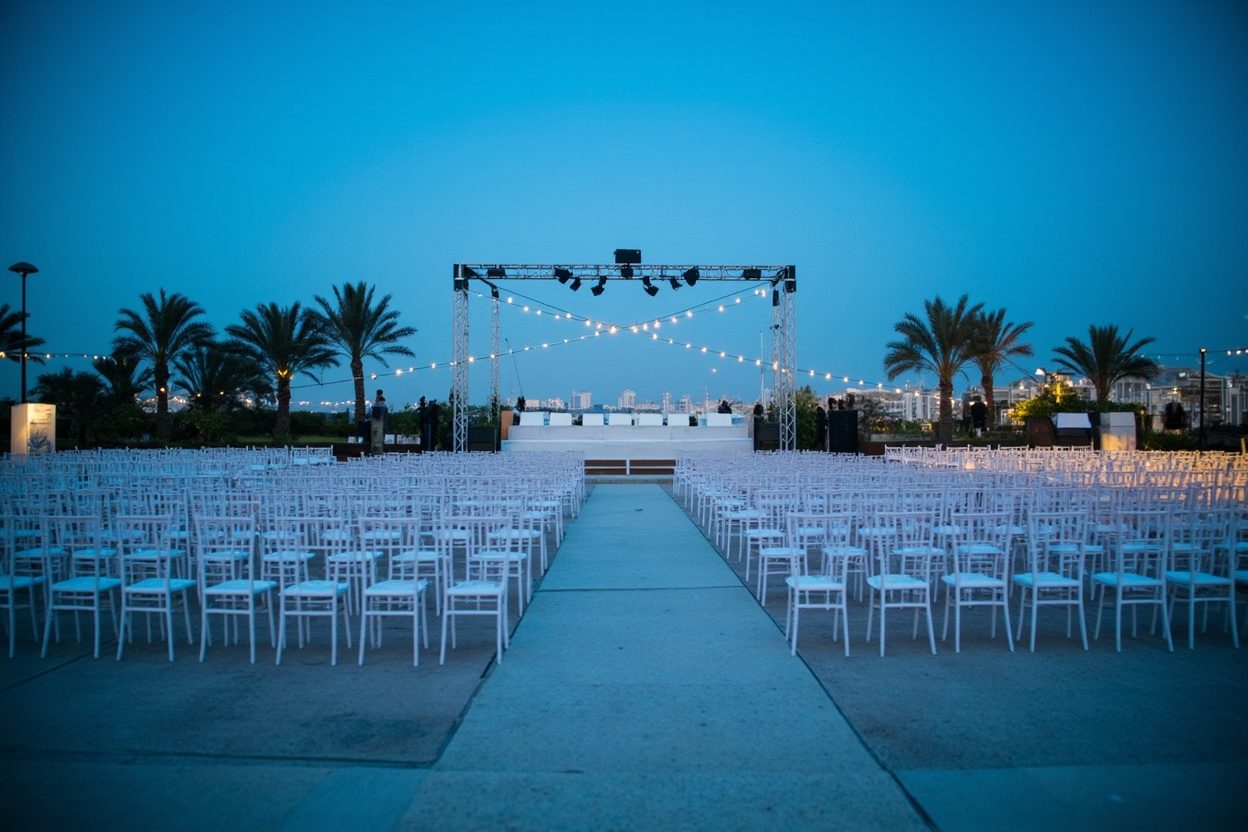
In short: Dubai Law No. (2) of 2026 on public safety came into force on 1 June 2026 and is overseen by Dubai Municipality's Environment, Health and Safety Agency. It requires venues and events to provide fire-fighting equipment, evacuation measures, first aid, trained safety supervisors, alarms, safety signage and a public safety management plan, and it bans handling fireworks without authorisation. Fines run from AED 500 to AED 1,000,000, and those affected have two years to comply.
Published 26 September 2026. Carving Dreams, Dubai.
Last checked against the sources below: 26 September 2026.
October is when Dubai moves back outdoors. Brand launches return to terraces and beaches, weddings move onto lawns, and productions that waited out the summer start building sets in the open. This year all of that happens under a law that did not exist twelve months ago.
The law was issued on 6 March 2026 and has applied since 1 June, but the summer heat meant few large outdoor events tested it. The coming season is the first real one. This note sets out what the law says, drawn from the Government of Dubai Media Office announcement, what it does not yet say, and the practical questions an organiser, a couple or a producer should be asking the venue now.
What is Dubai Law No. 2 of 2026?
It is the emirate's new framework for public safety. The Government of Dubai Media Office reported on 6 March 2026 that Sheikh Mohammed bin Rashid Al Maktoum, in his capacity as Ruler of Dubai, had issued Law No. (2) of 2026 on public safety in the Emirate of Dubai, effective from 1 June 2026 and to be published in the Official Gazette.
Its reach is wide. It covers venues and events, maintenance of inhabited buildings and homes, electrical devices and equipment, swimming pools and beaches, and products sold for human use, entertainment or education. It replaces Local Order No. (11) of 2003 on public health and community safety.
The stated aims include protecting lives and property, reducing injuries and damage from accidents, and enforcing public safety in venues and events in support of Dubai's tourism and leisure sectors. For anyone who works in events, that last line is the one to notice: venues and events are named in the law's purpose, not added as an afterthought.
Who enforces it?
The law gives Dubai Municipality's Environment, Health and Safety Agency responsibility for overseeing and regulating public safety in the emirate, in coordination with the relevant authorities. According to the Media Office announcement, employees of the Municipality, and of relevant authorities designated by the Municipality's Director General or by their own heads, have judicial enforcement powers. They can document violations, write reports and, where needed, involve the police.
That coordination clause matters in practice. Events in Dubai already pass through several bodies, and the new law does not replace them. It sits alongside the permits a project already needs, which is why the rest of this note keeps both in view.
What does the law require from venues and events?
The Media Office summary lists two groups of requirements. The first is a set of standards the venue or event must meet:
- Equipment standards. Equipment used at the venue or event must be safe.
- Lighting and ventilation. Both must be adequate.
- Safe entry and exit. People must be able to get in and out safely.
- Occupancy limits. A limit on the number of people allowed inside, to prevent overcrowding.
- Noise controls. Sound levels controlled to avoid hearing hazards and excessive exposure.
The second is a list of things the venue or event must provide:
- fire-fighting equipment;
- emergency evacuation measures;
- first-aid supplies;
- trained safety supervisors;
- alarm systems;
- safety signage;
- a public safety management plan to protect attendees.
The law also says owners, operators and service providers must comply with it, its regulations and the guidelines set by the authorities. It places duties on the public too: following safety instructions and evacuation procedures at venues and events, cooperating with safety supervisors, and staying out of areas reserved for staff.
What the announcement does not do is define thresholds. It does not say how many guests make a gathering an "event" for these purposes, what a public safety management plan must contain, what training a safety supervisor needs, or what decibel level counts as excessive. Those details are for regulations and guidelines, and we could not find them published as of 26 September 2026.
Fireworks, pyrotechnics and "unsafe products"
The law prohibits handling explosives, fireworks, toxic or flammable materials or other unsafe products without authorisation. It also forbids anyone from carrying out an activity that poses a risk to public safety unless the relevant authorities have authorised it and every public safety requirement is met.
For fireworks, the authorisation route already exists. The Security Industry Regulatory Agency (SIRA) publishes a Firework Show Permit service, and its terms are worth reading before anyone promises a couple or a client a display:
| Point | What SIRA's service page says |
|---|---|
| Who applies | A business that is accredited by SIRA to organise fireworks displays. It is not an application a venue, planner or couple makes for themselves. |
| Documents | Trade licence; a no-objection certificate from the organising entity; a map of the launch site and safety distances; a fireworks transportation request form. |
| How | Request by email to dg@sira.gov.ae, approval by the department officer, then fee payment. |
| Fees | Service fee AED 1,020, plus AED 10 knowledge fee and AED 10 innovation fee. |
| Time | Two business days. |
| After the permit | The fireworks company must notify the Dubai Civil Aviation Authority, the Coast Guard, the Dubai Civil Defence General Directorate, the General Department of Operations and the General Department of Authorities, Establishments and Emergency. |
Two practical points follow. The organising entity's no-objection certificate means the venue or event organiser is part of the paperwork even though the fireworks company applies. And the notifications list includes the Dubai Civil Aviation Authority and the Coast Guard, which is a reminder that waterfront and beach displays involve more parties than a garden one.
Drone light shows are a different question. They are aviation, not pyrotechnics, and in 2026 they sit under the GCAA's suspension of drone operations. Our note on bringing camera equipment into the UAE sets out what that safety decision says, and our drone filming guide covers the permit side. Confirm the current status in writing before building a drone show into any plan.
What are the fines?
The Media Office announcement gives the range: AED 500 to AED 1,000,000 for violating the law, its regulations or guidelines. A repeat offence within one year can be fined double, up to AED 2,000,000. Gulf Business reported the same figures on 7 March 2026.
The law leaves the detail to the Executive Council of Dubai, which will specify which acts are violations and the fine for each. We have not found that schedule published. Until it is, anyone quoting a specific fine for a specific event breach is going beyond what has been announced.
Two further points from the announcement are worth knowing. First, a person affected by a decision or measure under the law can appeal in writing within 10 working days of being notified; a committee decides within 30 days, and its decision is final. Second, the law says Dubai Municipality and the relevant authorities are not liable for harm caused by an owner's failure to meet public safety requirements. The owner alone is responsible.
Is there a grace period?
Yes. Everyone affected must comply within two years, and the Executive Council can approve one extension of the same length on the Municipality's recommendation. Counting from the 1 June 2026 start date, two years runs to mid-2028.
Do not read that as two years of freedom. The law also says that regulations, decisions and guidelines issued under the old Local Order No. (11) of 2003 stay in effect, as far as they do not conflict with the new law, until new ones replace them. The safety rules that applied to venues before June did not disappear when the old order was annulled. And the permits an event already needed, from the Department of Economy and Tourism, SIRA or anyone else, are not suspended by a grace period in a different law.
What should an organiser ask the venue now?
Most of the law's obligations land first on owners and operators, which for an event means the venue. The organiser's job is to know what the venue has in place and where the event adds something the venue did not plan for: a stage, a crowd larger than usual, a sound system, a fire feature. These are the questions we would put to a venue before signing:
- Ask for the occupancy limit in writing. The law names occupancy limits. Know the figure for the space you are booking, and plan the guest list, crew and suppliers inside it, not just the guests.
- Ask who the trained safety supervisor is. Find out whether the venue provides one for your event or expects you to, and what training they hold.
- Ask to see the evacuation plan and the public safety management plan. Then check that your layout does not block the exits or routes in it. Stages, bars, photo walls and catering stations are the usual culprits.
- Agree the sound limits. Noise control is written into the law. Get the venue's limit and any curfew before booking a band or DJ, and share it with them.
- Clear any fire feature early. Fireworks need a SIRA-accredited company and a SIRA permit. Anything else with flame, fuel or pressurised gas deserves the same early question: who authorises this, and who applies?
- Put responsibilities in the contract. The law holds owners responsible for their own failures. Write down who provides which safety item, so nothing falls between the venue, the organiser and the suppliers.
Weddings: what changes for couples?
For most couples, very little changes in the paperwork. As our destination wedding guide explains, the Department of Economy and Tourism treats weddings as private activities, and a private activity permit is applied for once the venue is secured. The public safety law does not replace that.
What changes is the checklist behind it. A wedding for a few hundred guests on a lawn or beach has the same exposure as any other outdoor event: temporary structures, lighting, sound, catering, crowds and, often, a request for fireworks. The venue questions above apply in full. Our wedding planning page covers how the pieces of a Dubai wedding usually fit together, and the event catering page covers the food side, which carries its own rules.
Shoots and sets: does the law apply to filming?
A film set is not named in the announcement, but the law is written broadly: it covers the use of equipment, activities that pose a risk to public safety, and the handling of flammable materials. A location shoot with a crowd of extras, a lighting rig on a public space or a practical fire effect sits squarely in that territory.
It does not replace the filming permit. Our guide to how to film in Dubai sets out the Dubai Film and TV Commission route, which still applies in full. The sensible reading is that the safety plan a responsible production already writes, covering rigging, power, fire, crowd control and first aid, now sits against a specific law with specific fines. Productions shooting outdoors this season should also plan around heat and early morning fog, which our note on Dubai's 2026 to 2027 shooting season covers.
What is still unknown?
As of 26 September 2026, we could not find the following published:
- the full text of the law in English on an official portal we could open;
- the Executive Council's list of violations and the fine for each;
- the regulations and guidelines setting out what a public safety management plan, a trained safety supervisor or a safe noise level means in practice;
- any guidance on how the law applies to private events such as weddings, as opposed to public venues.
We will update this note when Dubai Municipality or the Executive Council publishes them. Anything a third party presents as settled on those points deserves a check against an official source first.
The short version
Dubai's public safety law has applied since 1 June 2026. It puts venues and events at the centre of a new framework run by Dubai Municipality, with fines from AED 500 up to AED 1,000,000 and a two-year window to comply. Fireworks still need a SIRA-accredited company and a SIRA permit, and every other permit an event or shoot already needed still applies. If you are planning a launch, a wedding or a shoot this season and want to talk through the order of approvals and the questions for the venue, write to lata@carvingdreamsevent.com.
Questions
- When did Dubai's public safety law come into force?
- Law No. (2) of 2026 on public safety was issued on 6 March 2026 and has applied since 1 June 2026. Those affected have two years to comply, with one possible extension of the same length.
- Who enforces the public safety law in Dubai?
- Dubai Municipality's Environment, Health and Safety Agency oversees it, in coordination with the relevant authorities. Designated employees can document violations and involve the police where needed.
- How much are the fines under Dubai's public safety law?
- Fines range from AED 500 to AED 1,000,000, and a repeat offence within a year can be fined double, up to AED 2,000,000. The Executive Council of Dubai will set out which acts are violations and the fine for each.
- Can we have fireworks at a wedding or event in Dubai?
- Only through a company accredited by SIRA to organise fireworks displays, which applies for SIRA's Firework Show Permit with a no-objection certificate from the organising entity and a site map with safety distances. Handling fireworks without authorisation is prohibited.
- Does the public safety law replace event or filming permits?
- No. It sits alongside them. Weddings still need a private activity permit, public events still need their permits, and filming still goes through the Dubai Film and TV Commission route.
Planning something in the UAE?